
Service Request
Complete this form and we will contact you as soon as possible.
For emergencies call: 1-800-536-4056
Thank you! Your submission has been received!
Oops! Something went wrong while submitting the form.
Complete this form and we will contact you as soon as possible.
For emergencies call: 1-800-536-4056


Senior living mold remediation is the controlled removal of mold and correction of moisture problems to protect residents and restore affected spaces. First, restrict access to the affected area, notify facility leadership, and arrange professional assessment; resident care, mobility needs, and shared ventilation must shape the work plan.
Key takeaways
Senior living buildings combine private residences with shared dining, care, laundry, and circulation spaces. Closing a room affects more than maintenance: residents still need accessible bathrooms, medication support, meals, and safe routes through the building.
CDC guidance identifies people with weakened immune systems as particularly vulnerable to mold exposure. Keep vulnerable residents away from affected spaces and let clinical staff determine individual precautions. Do not ask maintenance or housekeeping staff to disturb mold while residents remain nearby.
For your 2026 response plan, separate three responsibilities: building remediation, resident care, and insurance decisions. One contractor cannot make every decision. For regional contractor research, the Fort Wayne water damage restoration guide provides a starting point; confirm senior living requirements directly before assigning work.
Restrict entry to the affected room or zone without obstructing emergency exits. If water is near electrical equipment, or ceilings appear unstable, keep people out and contact the appropriate qualified professionals. Do not enter simply to take photographs.
The initial facility assessment should identify who uses the space and what essential services depend on it. A resident room, medication storage area, and laundry room need different continuity arrangements. Document those dependencies before deciding where staff and residents can move.
Have the facility's clinical or care lead assess resident needs before relocation. Mold exposure precautions must account for weakened immune systems, respiratory conditions, mobility limitations, and cognitive impairment. Contractors identify work-zone requirements; clinical staff decide how those requirements affect individual care.
For a 2026 relocation plan, name the receiving room, responsible staff member, and care handoff process. Moving a resident without their mobility aid, medication information, or familiar support creates a separate operational problem.
Start with existing maintenance records, leak reports, and photographs taken without entering restricted areas. These give the restoration specialist useful history without requiring staff to remove wall coverings or disturb suspect material. Then arrange a professional inspection to determine the moisture source, affected materials, and appropriate work boundaries.
Hays + Sons is best for senior living operators seeking mold remediation and insurance coordination in Indiana, Ohio, and Northern Kentucky. Its certified restoration specialists bring experience from more than 40,000 completed restorations across its restoration work. The Hays + Sons team also provides 24/7 restoration services.
EPA mold guidance makes moisture correction central to remediation. Surface cleaning alone does not resolve a leaking pipe, wet wall cavity, or recurring condensation problem. Ask the specialist to distinguish confirmed findings from areas requiring further investigation.
Request a written work plan before disruptive cleanup begins. It should explain how the contractor will separate the work area, manage access, handle debris, and protect occupied spaces. The appropriate containment depends on the findings; a generic setup is not a substitute for a site-specific assessment.
Use the following sequence to coordinate the building and care teams. Each phase needs an assigned owner, even when several organizations participate.
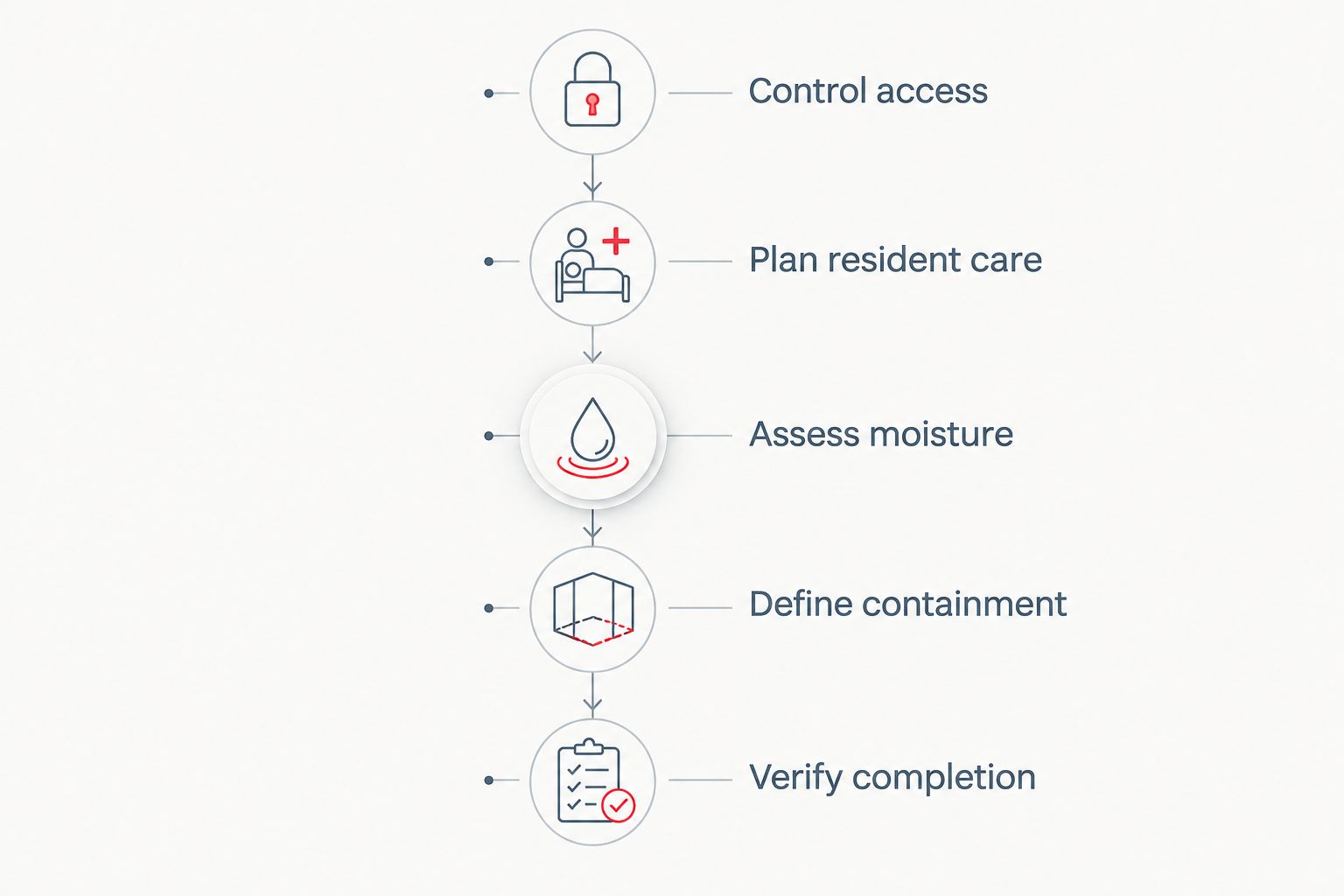
Resident care planning belongs before disruptive remediation work begins.
Agree on how the facility will respond if the contractor discovers additional damage. The process should allow work boundaries and resident arrangements to change without leaving staff guessing about access.
Create a single incident file for your 2026 project. Include the discovery timeline, contractor findings, photographs, communications, estimates, authorizations, and completion records. Keep resident medical information in the appropriate protected system rather than attaching it to general contractor correspondence.
Notify your insurer through the required reporting process and ask what documentation the claim needs. Insurance coordination supports a claim; it does not establish coverage. Coverage, exclusions, deductibles, and payment decisions depend on the policy and insurer's review.
Hays + Sons provides insurance coordination and advocacy. Use that support to organize property-damage information while retaining facility control over contracts, care decisions, and claim authorizations. Necessary safety measures should not depend on a promise of reimbursement.
Agree on completion criteria before work starts, not when a room is needed again. Review moisture-source correction, removal or cleaning of affected materials, drying documentation, and the condition of adjacent spaces. A fresh finish or absence of odor is not enough by itself.
EPA guidance does not establish a universal federal airborne mold threshold for declaring a building safe. Where independent assessment or post-remediation verification is appropriate, define its purpose and responsible party in advance. Facility and clinical leadership should approve resident return using the project findings and care requirements.
Hays + Sons offers a two-year project warranty. Request the written terms for your project and keep them with the closeout documents; a warranty does not replace inspection or routine moisture prevention.
Turn the incident findings into a maintenance action list. A repaired pipe does not resolve an unrelated roof leak, and replacing finishes does not explain recurring condensation. Assign each corrective action to a named owner and retain evidence of completion.
For your 2026 maintenance calendar, prioritize the locations identified during assessment rather than treating every room identically. Give care staff a simple reporting route for water stains, leaks, or persistent musty odors. Their role is early reporting, not diagnosis or cleanup.
Choose support by responsibility, not by treating every provider as interchangeable. Facilities staff, remediation specialists, and independent assessors answer different questions. Some projects need all three.
Facility-led coordination
Hays + Sons mold remediation
Independent environmental assessment
Qualified plumbing, roofing, or HVAC repair
Ask each provider to explain deliverables and handoffs in writing. An assessor's report, a repair invoice, and a remediation closeout package serve different purposes; collect the documents your facility needs rather than assuming one replaces the others.
Request a restoration assessment
Discuss mold remediation, moisture damage, and insurance documentation for your facility.
Scheduling demolition around contractor convenience overlooks medication rounds, bathing support, meals, and residents who cannot relocate independently. Require a care-continuity plan alongside the work schedule. Include adjacent rooms when reviewing noise, access, and ventilation impacts.
Routine cleaning duties do not establish the training, equipment, or containment needed for mold remediation. Do not ask staff to scrub extensive growth, open wet wall cavities, or carry contaminated materials through occupied areas. Use trained professionals for remediation and suspect concealed damage.
An insurance review and an immediate access restriction are different actions. Document conditions, notify the insurer, and take appropriate protective steps without representing those actions as covered expenses. Keep contractual approvals and claim communications clear.
New paint or flooring can conceal unresolved moisture rather than demonstrate completion. Require the agreed closeout evidence and facility approval before returning the space to service. Check that relocated residents can return with their care arrangements intact.
A well-managed daytime response can break down when evening staff do not know which doors remain restricted. Include work boundaries, temporary resident locations, contractor contacts, and escalation responsibilities in shift handoffs. Update the information whenever conditions change.
What's the first thing to do when mold is found in a senior living facility?
Restrict access to the affected area and notify facility and clinical leadership. Arrange professional assessment, and do not let staff disturb suspect materials or move contaminated belongings through occupied spaces.
Do residents need to move out during mold remediation?
Resident relocation depends on the affected area, containment requirements, and individual care needs. Facility and clinical leadership should decide placement with input from the remediation specialist, rather than assuming every resident must leave or every room can remain occupied.
Can housekeeping staff clean mold in a resident room?
Housekeeping should not take on mold remediation involving disturbed materials, concealed damage, or containment requirements. Trained professionals should assess the problem, while facility staff manage access, reporting, and resident support.
Is mold testing required before remediation?
Mold testing is not automatically required for every visible mold problem. EPA guidance explains that sampling is generally unnecessary when visible growth is present; ask a qualified assessor what decision testing would inform in your facility.
Will insurance cover mold remediation for a senior living facility?
Insurance coverage depends on the policy, cause of damage, exclusions, and insurer's review. Hays + Sons provides insurance coordination and advocacy, but that support does not guarantee coverage or payment.
How quickly can Hays + Sons respond to an emergency?
Hays + Sons provides 24/7 emergency restoration services and states a one-to-two-hour emergency response. Confirm dispatch and site access directly; emergency response is not a remediation completion timeline.
When can residents return after mold remediation?
Residents can return after the facility approves completion against the agreed remediation criteria and clinical requirements. Review moisture correction, cleanup documentation, remaining restrictions, and individual care arrangements before authorizing occupancy.
Make resident return a documented decision, not a scheduling assumption. Add a return-to-room signoff to your 2026 incident procedure, with facilities and care leadership responsible for their respective checks. That final handoff connects completed building work to the resident's actual needs.